A group that is not a chat
It is a board of intentions. Someone proposes dinner on Saturday and, when the others accept, the event is created by each person's own calendar on their own phone.
Nobody writes on anyone else's phone
The difference matters: there is no server putting things into the apps of your family. What travels is the proposal; what turns it into a real event is your own iPhone, when you accept it.
- A plan. Date, time and place, with a warning if it clashes with your calendar. When you accept, your own EventKit writes it.
- The shopping list. Shared, and anyone can pull a line down into their own Reminders with one tap. It never rings.
- Jobs with a name on them. "Dad, take the bins out" only rings for Dad.
- Polls and notes. To decide without twenty messages.
- Images. The one sent to the group is charged to whoever asked for it, never to whoever receives it.
- Shared documents. Nia answers about them citing the file and page.
A private walkie talkie for people who choose to listen
Turn your own listening on for a shift and hold to send a voice notice of up to thirty seconds. It is not a call, there are no public channels, and nobody can turn your listening on for you.
Hold to speak
Your voice only leaves when you choose radio and hold to speak. A notice reaches people who turned listening on in that group.
Private group
Only people with an invitation can join. There is no people discovery and no anonymous account in voice radio.
Plain privacy
Audio travels to the server to be passed on. There is no end to end encryption, nobody is identified by voice, and an ordinary notice disappears from memory after about thirty seconds.
Report and block
You can report a notice, block a member or remove them if you manage the group. A reported notice is kept for thirty days so it can be reviewed.
Your address book does not leave the phone
Knowing which of your contacts already use Nia would be handy. To get it, your address book would have to be uploaded to a server, even with the numbers turned into codes, and that does not work: the whole worldwide mobile number space is walked in a couple of minutes on a consumer graphics card, so an "anonymized" number comes apart just the same, and it is still personal data.
So Nia does not do it. Inviting someone is a one use code that Nia writes for you in WhatsApp or in Messages, with the handover that already exists. Contacts is read on the phone, only to address the message.
The other thing said plainly: inside a group there is no end to end encryption, and the group screen says so. There cannot be any on a server that has to hand things round, moderate, remember Saturday and make the image. What is true, that the address book and the exact location do not leave, is written there too.
What a group needs in order not to be a problem
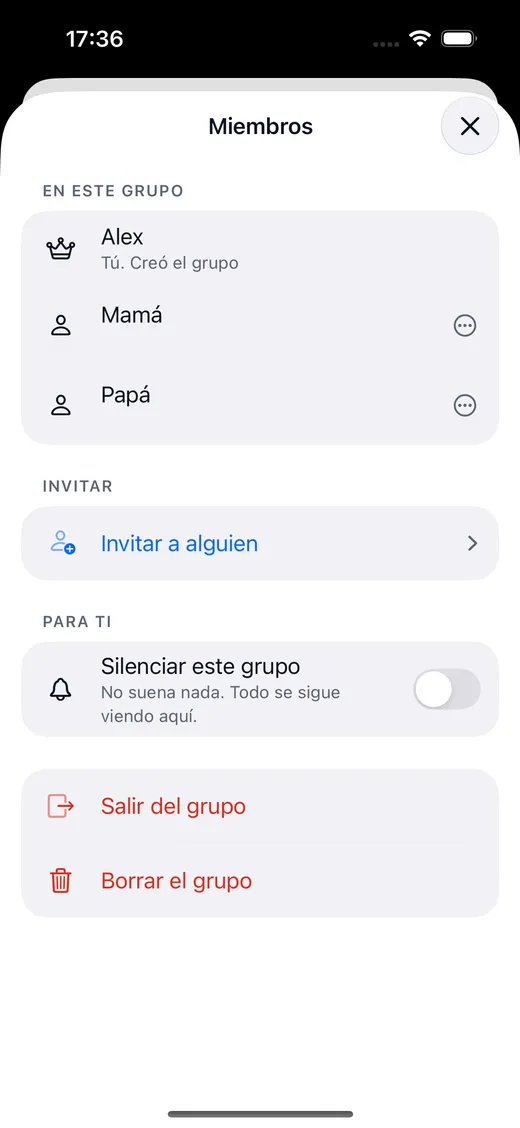
Mute
A muted group works exactly the same: the app never needs notifications in order to do its job.
Report and block
Report an item and block a person. Without this the app does not pass Apple review, and rightly so.
Leave, remove, hand over
Leave the group, remove someone if you are the one who created it, or hand the group to another person.
The house does not announce itself
Nia does not broadcast on its own that the apartment is empty. The state of the house is said by a person, on purpose.
Receiving is free
Joining a group of someone else costs nothing on any plan. The one who pays is the one who organizes.
Notifications with a face
A group alert arrives with the name of the group and the photo of whoever wrote it, and it can cross a Focus mode.
About groups
What are Nia groups for?
A Nia group is not a chat: it is a board of intentions that each member's Nia knows how to carry out. Someone proposes a dinner and, when the others accept, the event is created by each person's own calendar on their own phone. The shopping list, jobs given to someone by name, polls, shared documents and voice radio all work inside the same private group. Nothing is written on another person's phone unless their phone writes it.
Does group radio record my voice?
A voice notice is only sent when you turn radio on and hold to speak. There are no public channels and nobody can turn listening on for you. A notice lives in memory for about thirty seconds so it can reach people who chose to listen. If someone reports it, it is kept for thirty days so it can be reviewed. There is no end to end encryption and Nia does not identify anyone by their voice.
Does Nia read my contacts?
Only on the phone, and only when it is needed for what you asked: working out who you are calling or who you are writing to. Your address book is not uploaded to any server, not even to find out which of your contacts use Nia: a group invitation is a code that works once, and Nia writes it for you in WhatsApp or Messages.
Shall we begin?
Download Nia, tell it the first thing and see what happens. The free plan asks for no card.
Free to start. Requires iOS 18. In English and Spanish.